
Research & Publications
Unravelling the Truth
Self-Publications
Publication: self
May 2025
Navigating Chemical Space Using Genetic Hierarchical Fragment-Based Multi-Objective Optimization (GHiFMO)
Navigating Chemical Space Using Genetic Hierarchical Fragment-Based Multi-Objective Optimization (GHiFMO)
May 2025
Click image to zoom in
Summary:
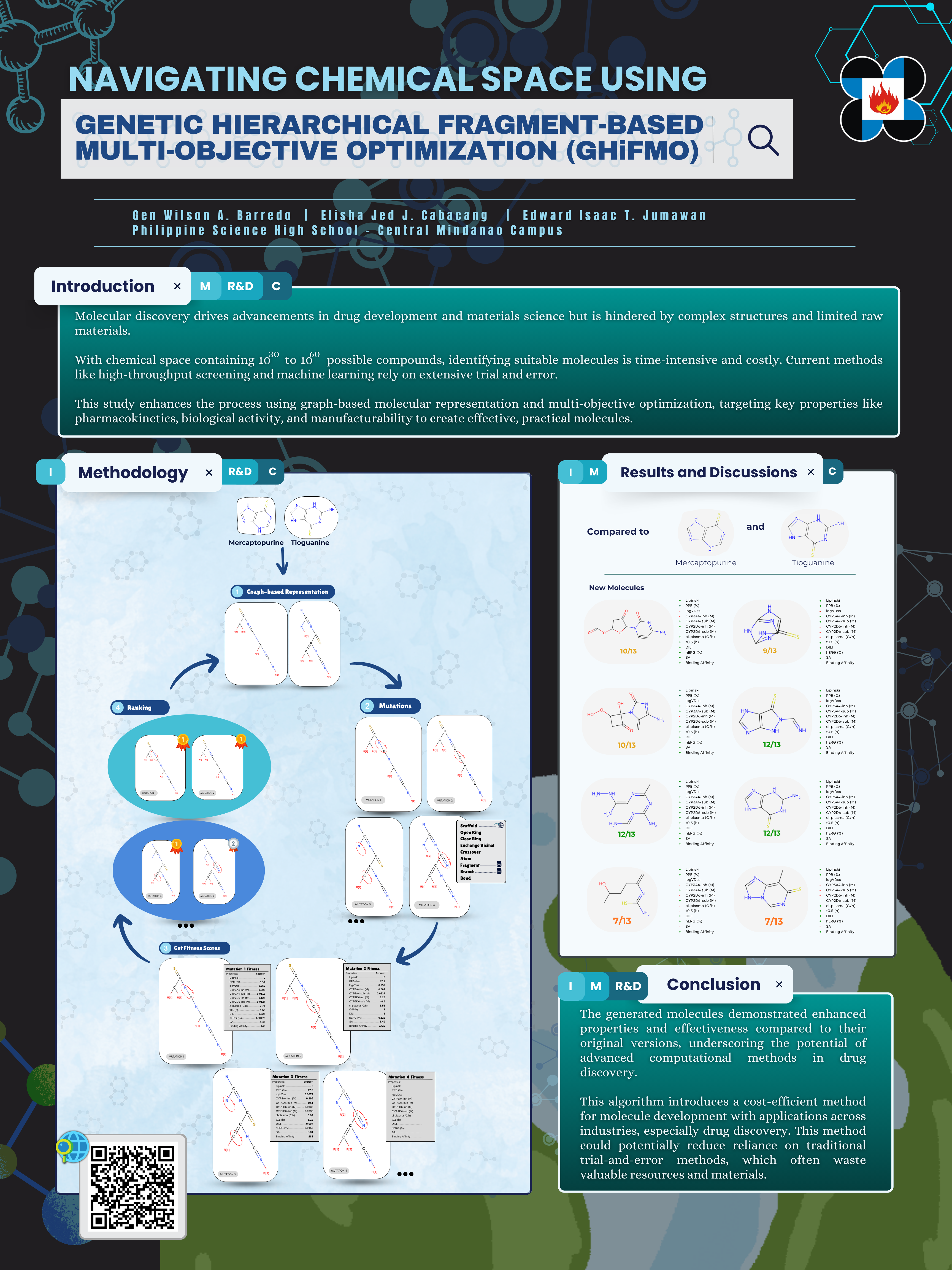
The study presents GHiFMO, a multi-objective molecular optimization framework that utilizes genetic algorithms to identify drug candidates with optimal profiles in binding affinity, synthetic accessibility, and ADMET. By applying this framework to target protein implicated in acute lymphoblastic leukemia (ALL), the researchers successfully generated novel purine analogues that met 12 out of 13 pre-defined pharmacological criteria, offering a possible drug alternative. As such, the suggested framework could serve as a transparent and efficient alternative to previous solutions.
Background & Problem:
Searching for more accessible and efficient drug alternatives is incredibly difficult as are between 10^30 and 10^60 possible drug-like molecules. Many existing methods often rely on trial-and-error which are time-consuming and expensive. AI solutions require a lot of data which may not be available for certain diseases. Additionally, these methods are 'black boxes' that cannot explain their decisions. So, we suggested a optimization-centric solution instead.
Methodology:
GHiFMO works as follows:
1. Initialization: The framework is given a target protein and drugs that, ideally though not necessarily, interact with it.
2. Representation: Molecules are represented hierarchically to prevent information loss during manipulation.
3. Digital 'Breeding' (Crossover): Swaps parts of 2 good molecules to see if the 'child' molecule is even better.
4. Random 'Mutations': Make small, random changes to atoms, bonds, rings, fragments, and scaffolds to find a new geometry.
5. Survival of the Fittest: Scores all molecules on 13 'fitness' tests in three categories: ADMET (how it interacts with the human body), Synthetic Accessibility (how easy it is to make), and Binding Affinity (how strong it binds to the target protein).
6. Selection: The best molecules (dominance) in each fitness test are kept for the next generation.
7. Repeat steps 3-6 until the desired number of molecules or number of generations is reached.
Findings:
- The framework generated a new molecule that were in ideal values in 12 out of 13 fitness tests
- These suggested drug scored better than the real-world drugs we currently use, Mercaptopurine and Tioguanine, which scored 9 and 10, respectively.
- The framework successfully balanced conflicting objectives.
Next Steps:
- Use maps of electron density to make sure the molecules are stable and will not interact with unintended molecules.
- One might possibly test this system on other proteins. It would be interesting to find alternatives for orphan drugs to have a more diverse set of treatments for rare diseases which are, unfortunately, usually ignored by big companies.
- Develop tools to visualize the molecular evolution process to provide even greater transparency into the system's decision-making and possibly help create better optimize the algorithm.
Authors:
Barredo, Gen Wilson (Coresearcher)
Cabacang, Elisha Jed (Coresearcher)
Jumawan, Edward Isaac (Coresearcher)
Lazaro, Sheila Marie B. (Research Adviser)
Yungco, Nicky C. (Statistics Consultant)